
New: SPNS Supporting Replication of Housing Interventions Request For Proposal (RFP)

SPNS Supporting Replication of Housing Interventions Request For Proposal (RFP)
SPNS Supporting Replication (SURE) of Housing Interventions Request For Proposal (RFP)

A Request for Proposal (RFP) is now available to Ryan White HIV/AIDS Program (RWHAP) service providers for a Special Project of National Significance (SPNS) program titled Supporting Replication (SURE) of Housing Interventions. It includes funding for up to 10 implementation sites that will implement and adapt housing-related intervention strategies for three priority populations of people with HIV experiencing unstable housing.

The purpose of the SURE Housing initiative is to implement and adapt housing-related intervention strategies for three priority populations of people with HIV experiencing unstable housing, who often have the highest HIV-related disparities:

1) people who identify as lesbian, gay, bisexual, transgender, and queer or questioning (LGBTQ+);
2) youth and young adults (aged 18-24); and
3) people who have been justice-involved (defined as any person who is engaged at any point along the continuum of the criminal justice system as a defendant including arrest, incarceration, and community supervision).

The goal of this initiative is to promote the replication of effective housing interventions in the RWHAP to decrease health and housing disparities and improve health outcomes along the HIV care continuum.  This initiative will engage and retain people with HIV experiencing unstable housing in HIV medical care and support services by addressing their housing and behavioral health needs, as needed.

Serving as the Implementation and Technical Assistance Provider, the Corporation for Supportive Housing (CSH), in partnership with Collaborative Solutions, Inc (CSI), will select, issue, and monitor sub-awards of up to $250,000 per funding year for up to ten implementation sites. Sites will be funded from May 1, 2023 – July 31, 2026. CSH and CSI will provide the sites with technical assistance (TA) for implementing and adapting these interventions.

The implementation sites will also participate in a multi-site evaluation to assess the effectiveness of the interventions’ implementation and adaptation. The implementation of housing-related interventions at each site will be evaluated by the Evaluation Provider comprised of Boston University, the University of Massachusetts, Lowell, and JSI Research & Training Institute, Inc.

Additional information can be found in the Request for Proposals.

Application Details

Current RWHAP service providers are eligible to apply. Applications are due no later than 11:59pm ET on February 15, 2023. To learn more about this opportunity, register here for a live webinar taking place on January 10, 2023 at 3PM Eastern.

For more information, contact HRSA.TA@CSH.ORG.

ViiV Healthcare HIV Medications to be Discontinued as of January 1, 2024

Announcement: ViiV Healthcare HIV Medications to be Discontinued as of January 1, 2024

ViiV Logo

Last year, ViiV Healthcare (“ViiV”) released a letter notifying health care providers

that the following products will be discontinued in the United States, and will no longer be distributed by ViiV as of January 1, 2024:

  • Lexiva (fosamprenavir) 700 mg Tablets and 50 mg/ml Oral Suspension
  • Trizivir (abacavir/lamivudine/zidovudine) 300 mg/150 mg/300 mg Tablets
  • Selzentry (maraviroc) 25 mg Tablets and 75 mg Tablets
  • Tivicay (dolutegravir) 10 mg Tablets and 25 mg Tablets
  • Ziagen (abacavir) 300 mg Tablets
  • Combivir (lamivudine/zidovudine) 150 mg/300 mg Tablets
  • Epzicom (abacavir/lamivudine) 600 mg/300 mg Tablets

In addition, in the letter ViiV stated it would no longer accept new Patient Assistance Program (PAP) applications for the products listed above after 07/01/22.

For any questions or concerns, please contact the ViiV Healthcare Customer Response Center at 1-877-844-8872.

Invitation to Participate: HIV Provider Training to Address Medical Mistrust

Hands holding red ribbon

Invitation to Participate: HIV Provider Training to Address Medical Mistrust

Who should participate?

  • HIV care providers (MD, DO, NP, PA) who primarily work with Black and Latinx patients

What does participation involve?

  • Virtual training (total 4 hours) conducted by California Prevention Training Center
  • Phone interview (45 min) to provide feedback that will be used to improve the training
  • $200 gift card will be provided

Who is conducting this research?

How can I participate?

For more information, please contact Bella González

Cell: (703)-413-1100 x5793

Email: igonzale@rand.org 

Read an official message from the RAND Corporation below:

“We are a team of researchers, HIV care providers, and provider training experts from the RAND Corporation, California Prevention Training Center, and Brigham & Women’s Hospital. We are conducting a study to develop and pilot test an HIV care provider training to understand and address the impact of stigma and medical mistrust experienced by Black and Latinx consumers/patients. This research is funded by the National Institute of Health, and the study protocol has been approved by RAND’s Institutional Review Board.

If you are an HIV care providers (e.g., physician, nurse practitioner, physician assistant) who works with a substantial number of Black and Latinx HIV care consumers or patients, we would like to invite you to participate in our study and provide feedback to improve this training. The tentative dates are in mid-January 2023 (e.g., potentially during the week of 1/9) and the participation would be remote/virtual. The total time would be about 4 hours for the virtual training (via Zoom) and there will be a phone interview (45-60 min) to provide qualitative feedback and suggestions for improvement. We may schedule a long session of 4 hours or break it up into two sessions, whichever would be most convenient/manageable. Your feedback would be used to refine and improve this provider training. You will be compensated $200 for participating in the training and interview. The training will be conducted by expert trainers from California Prevention Training Center; the interview will be conducted by RAND researchers.

Your participation in the training session(s) and interview are completely voluntary. We will not identify you in any way in any of our research presentations, papers, or reports. The information you provide to us during your participation will be kept confidential. If you are interested in participating, our research staff contacting you will review this information with you at the beginning of the training and interview and can answer any questions that you have at those times.

Please enter your contact information in this Google Form here if you are interested in participating in this study. If so, we will work with you to identify a convenient time to proceed with the next steps. Please feel free to contact us to ask any questions you may have about any aspects of this study. Our study contact is Dr. Lu Dong (ldong@rand.org, 310-486-1847).

Thank you for helping with this important project.”

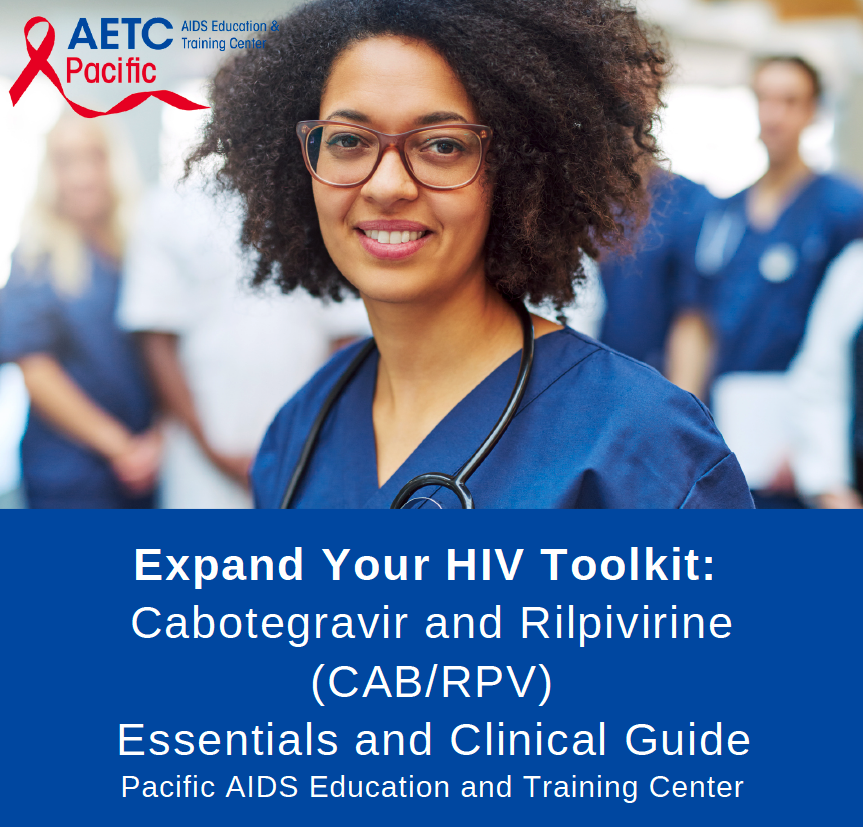
New Resource: Expand your HIV Toolkit: Cabotegravir and Rilpivirine (CAB/RPV) Essentials and Clinical Guide

Cover of the Expand your HIV Toolkit: Cabotegravir and Rilpivirine (CAB/RPV) Essentials and Clinical Guide

Pacific AETC has developed the Expand Your HIV Toolkit: Cabotegravir and Rilpivirine (CAB/RPV) Essentials and Clinical Guide to inform healthcare providers about CAB/RPV, the first FDA-approved long-acting injectable antiretroviral (ARV) medication for patients with HIV. This comprehensive toolkit includes:

  • Recommendations for patient evaluation, screening, and shared decision making when considering prescribing CAB/RPV.
  • Implementation tools such as sample checklists, protocols, and resources available to aid in the implementation of offering CAB/RVP in healthcare settings.  

The toolkit was developed to enhance the content of a 4-part webinar series held January – April, 2022, titled: Expand your HIV Toolkit: CA Statewide Trainings on Extended-Release Injectable Suspensions for HIV Treatment and Prevention.  The series was designed to equip California clinicians, pharmacists, and members of the healthcare team with an in-depth understanding of Cabotegravir/Rilpivirine (Cabenuva). Attendees gained:

  • Real-world patient and provider perspectives.
  • A guide to patient eligibility, clinical considerations, and insurance coverage.
  • Insights to increase equitable access for priority populations. 

Register below to watch the 4-part series and access materials.

Upcoming! Routine Testing in Clinical Setting: A Webinar Series to Showcase Partnerships that Maximize Opt-out HIV Screening

Denver PTC LogoMore than 160,000 Americans are unaware they are living with HIV. Diagnosing HIV is critical to the success of the Ending the HIV Epidemic in America initiative (EHE). How can we assist clinical providers in identifying individuals who would not otherwise receive HIV testing? Research demonstrates large-scale HIV screening in the emergency departments and urgent care settings using existing staff and resources, regardless of patient selection strategy, does not impact care processes or patient flow.
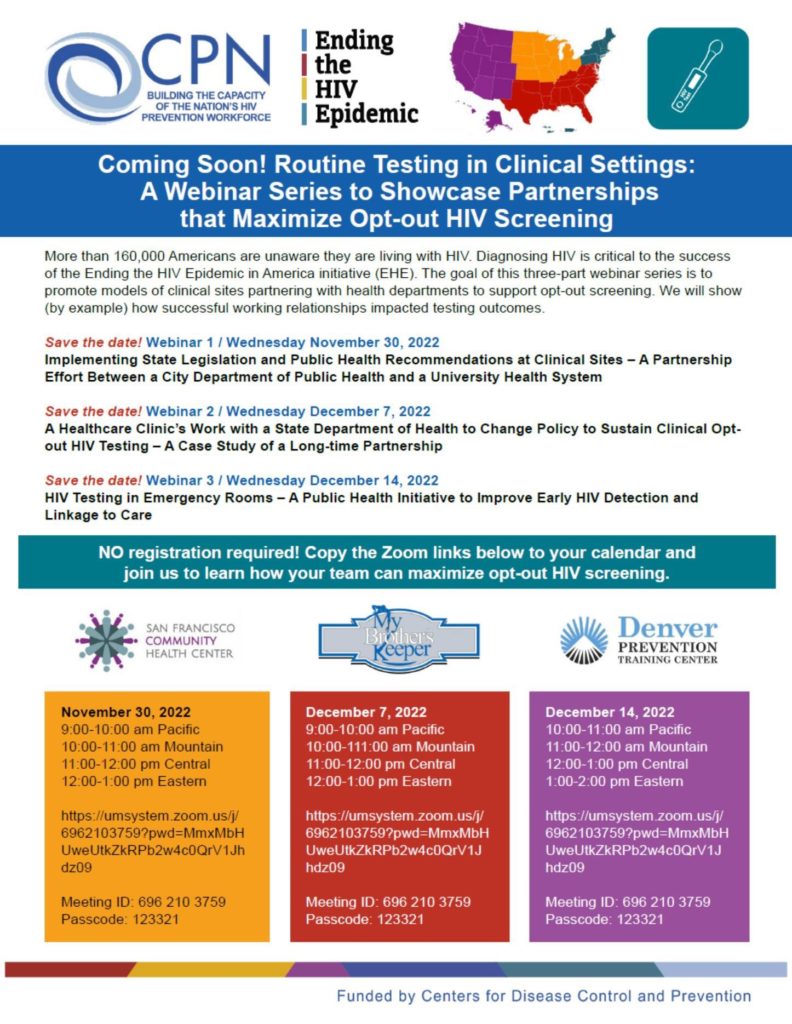

Join the Denver PTC on Wednesday December 14, 2022 as they deliver a webinar on HIV Testing in Emergency Rooms – A Public Health Initiative to Improve Early HIV Detection and Linkage to Care.

No registration is required. Access the Zoom information below:

(https://umsystem.zoom.us/j/%206962103759?pwd=MmxMbHUweUtkZkRPb2w4c0QrV1Jhdz09)

Meeting ID: 696 210 3759

Passcode: 123321

Learn how your team can maximize opt-out HIV screening!

Early HIV Diagnosis and Treatment Important for Better Long-term Health Outcomes

Cross-posted from NIAID Newsroom

NIAID NewsroomStarting antiretroviral treatment (ART) early in the course of HIV infection when the immune system is stronger results in better long-term health outcomes compared with delaying ART, according to findings presented at the IDWeek Conference in Washington, D.C.

The findings are based on an extended follow-up of participants in the National Institutes of Health-funded Strategic Timing of Antiretroviral Treatment (START) study. In 2015, START demonstrated a 57% reduced risk of AIDS and serious non-AIDS health outcomes among participants who began ART when their CD4+ T-cell counts—a key indicator of immune system health—were greater than 500 cells per cubic millimeter (mm³) compared with those who did not begin ART until either their CD4+ counts fell below 350 cells/mm³ or they developed AIDS. Following the 2015 report of these findings, the participants in the deferred treatment arm were advised to begin ART.

Approximately, 1.2 million people in the United States are living with HIV, and roughly 13% do not know they are infected, according to the Centers for Disease Control and Prevention. When HIV diagnosis and treatment are delayed, HIV continues to replicate. This can negatively impact the infected individual’s health and increase the risk of transmitting the virus to others.

The international START study proved the benefit of early ART initiation, but longer-term follow-up of 4,446 participants was undertaken to determine whether the health benefits of early ART compared with deferred ART increased, remained constant, or declined after the participants in the deferred arm were advised to begin ART. The primary study endpoints included the number of participants who developed AIDS; those who developed serious non-AIDS health conditions, such as major cardiovascular disease, kidney failure, liver disease and cancer; and those who died.

For participants who began ART before the end of 2015, the median CD4+ cell count at the time of ART initiation was 648 cells/mm³ for the immediate arm and 460 cells/mm³ for the deferred arm. The analysis presented [on 10/21/22] compared the primary study endpoints before the end of 2015, with those in the extended follow-up period, from Jan. 1, 2016, to Dec. 31, 2021. In the latter period, most deferred-arm participants were taking ART. During the second period, people initiating ART in the deferred group had rapid and sustained declines in HIV viral load (less than or equal to 200 copies/mL); however, CD4+ cell counts remained, on average, 155 cells lower compared with that of individuals in the immediate ART group. While the risk of serious health outcomes was substantially diminished soon after ART was initiated in the deferred treatment group, some excess risk remained compared with the immediate treatment group. The deferred ART group continued to have a somewhat greater risk (21%) of serious health consequences or death in comparison to the immediate treatment group. Twenty-seven cases of AIDS occurred in the five-year follow-up period in the deferred treatment group compared with 15 cases in the early treatment group. Similarly, 88 cases of serious non-AIDS health issues occurred in the deferred treatment arm compared with 76 cases in the immediate treatment arm. Lastly, there were 57 deaths in the deferred treatment group compared to 47 in the immediate treatment arm.

These findings confirm that ART significantly improves the health of an individual with HIV and reduce the person’s risk of developing AIDS and serious health issues, and that early diagnosis and treatment are key to maximizing these benefits and reducing risk, according to the presenters.

The START study and its extended follow up was conducted by the International Network for Strategic Initiatives in Global HIV Trials (INSIGHT), funded in part by the National Institute of Allergy and Infectious Diseases (NIAID), part of NIH. It was led by principal investigator James D. Neaton, Ph.D., of the University of Minnesota, Minneapolis, and START study co-chairs Abdel Babiker, Ph.D., of the University College London, and Jens Lundgren, M.D., of the University of Copenhagen.