Updates to the Guidelines for the Use of Antiretroviral Agents in Adults and Adolescents with HIV (September 21)

hivinfo.nih.gov logoUpdates to the Guidelines for the Prevention and Treatment of Opportunistic Infections in Adults and Adolescents with HIVThe Panel on Antiretroviral Guidelines for Adults and Adolescents (the Panel) updated several sections of the Guidelines for the Use of Antiretroviral Agents in Adults and Adolescents with HIV.

Highlights from the sections are summarized below:

Selection of Antiretroviral Therapy for Individuals Who Acquire HIV After Having Received Long-Acting Cabotegravir for Pre-Exposure Prophylaxis

In this update, several sections of the guidelines have been revised with discussions on factors that clinicians should consider when selecting an antiretroviral (ARV) regimen for individuals who acquire HIV after having received long-acting cabotegravir (CAB-LA) for HIV pre-exposure prophylaxis (PrEP). Because of the long half-life of CAB-LA, the Panel recommends performing genotypic resistance testing, including testing for integrase resistance, before starting antiretroviral therapy (ART). If resistance testing results are not available before ART initiation, the Panel recommends initiating a boosted darunavir regimen while awaiting results confirming no resistance to the integrase strand transfer inhibitor (INSTI) drug class. The sections updated with this new information include the following:

Laboratory Testing for Initial Assessment and Monitoring of Patients with HIV Receiving Antiretroviral Therapy

Drug-Resistance Testing

What to Start

Early (Acute and Recent) HIV Infection

Dolutegravir and Neural Tube Defects

Previously, the Tsepamo study from Botswana reported a higher prevalence of neural tube defects (NTDs) in women who received dolutegravir (DTG) during conception than with other ARV drugs. An updated report from the same study showed that the prevalence of NTDs is not significantly different from those on non-DTG regimens. For persons of childbearing potential who are trying to conceive, DTG-based regimens are among the recommended options for most individuals initiating ART. The following sections have been updated with this new information:

What to Start

Women with HIV

Transgender People and HIV

Laboratory Testing

The Panel updated the following sections relating to laboratory tests to be done at the time of ART initiation and the frequency of monitoring during follow-up:

Laboratory Testing for Initial Assessment and Monitoring of Patients with HIV Receiving Antiretroviral Therapy

Plasma HIV-1 RNA (Viral Load) and CD4 Count Monitoring

Drug-Resistance Testing

This section has been updated with two key new recommendations:

The Panel now recommends drug-resistance testing for people with virologic failure and HIV-RNA levels >200 copies/mL (AI for >1,000 copies/mL, AIII for 501–‍1,000 copies/mL,CIII for confirmed HIV RNA 201–500 copies/mL). For people with confirmed HIV-RNA levels >200 copies/mL but <500 copies/mL, drug-resistance testing may be unsuccessful but should still be considered.

The Panel previously recommended that resistance testing should be done within 4 weeks of discontinuation of an ARV regimen. However, given the long half-lives of the long-acting injectable ARV drugs, resistance testing (including testing for resistance to INSTIs) should be performed in all persons who have experienced virologic failure on a regimen of long-acting CAB-LA and rilpivirine (RPV) or acquired HIV after receiving CAB-LA as PrEP, regardless of the amount of time since drug discontinuation (AIII).

Optimizing Antiretroviral Therapy in the Setting of Viral Suppression

This section has been revised with the following key updates:

The Panel recommends that for regimen optimization in the setting of existing nucleoside reverse transcriptase inhibitor (NRTI) resistance, two NRTIs—tenofovir alafenamide or tenofovir disoproxil fumarate plus emtricitabine (FTC) or lamivudine (3TC)—should be included in the regimen with a fully active drug that has a high resistance barrier, such as DTG, boosted darunavir (BIII), or bictegravir (CIII).

The Panel recommends that pregnant persons who present to care on CAB-LA and RPV should be switched to a Preferred or an Alternative three-drug ARV regimen recommended for use in pregnancy per the Perinatal Guidelines (AIII).

Virologic Failure

This section has been updated to harmonize with the recommendations in the Drug-Resistance Testing section of the guidelines with regard to drug-resistance testing in patients in a failing long-acting ARV regimen and recommendations for resistance testing in patients with HIV viral load >200 copies/mL. The section also added clinical trial data from the DAWNING and NADIA studies, in assessing the roles of an INSTI or boosted protease inhibitor–based regimen in patients with failure to first-line non-nucleoside reverse transcriptase inhibitor–based regimens.

Adherence to the Continuum of Care

This section continues to stress the importance of assessing adherence and assisting patients to ensure uninterrupted access to treatment and care. The section also noted that the Panel recommends against the use of CAB-LA and RPV in people who have detectable viral load due to suboptimal adherence to ART and who have ongoing challenges with retention in HIV care, except in a clinical trial (AIII).

Other Updates

Minor updates have been made to the following sections:

Baseline Evaluation

Hepatitis B Virus/HIV Coinfection

Hepatitis C Virus/HIV Coinfection

Cost Considerations and Antiretroviral Therapy

For a complete list of updates, please see What’s New in the Guidelines. To view or download the guidelines, please see the Adult and Adolescent ARV Guidelines section of Clinical Info’s website. The guidelines tables and recommendations can also be downloaded as separate PDF files.

Clinical Info welcomes your feedback on the latest revisions to the Guidelines for the Use of Antiretroviral Agents in Adults and Adolescents with HIV. Please send your comments with the subject line “Adult and Adolescent ARV Guidelines” to HIVinfo@NIH.gov by October 13, 2022.

New: ACHA Releases Brief “Emerging Considerations for Addressing MPV in Higher Education Settings: Promoting Health Equity and Reducing Stigma” (September 1, 2022)

ACHA logo
The American College Health Association’s MPV Working Group Releases “Emerging Considerations for Addressing MPV in Higher Education Settings: Promoting Health Equity and Reducing Stigma”

The purpose of this brief is to offer considerations and resources for promoting health equity and reducing stigma to assist college health professionals with decision-making as the science of MPV and the current outbreak evolve.

This ACHA series, “Emerging Considerations for Addressing MPV in Higher Education Settings,” aims to supplement available CDC guidance to support college health clinical and health promotion professionals

Authors of the Brief:

  • Blake Flaugher
  • Lindsey Mortensen
  • Trevy Chai
  • Rachel Mack
  • Alex Phelan
  • Danielle Monroe
  • Robyn Buchsbaum

74th Presidential Advisory Committee on HIV/AIDS (PACHA Council) (September 19 & 20)

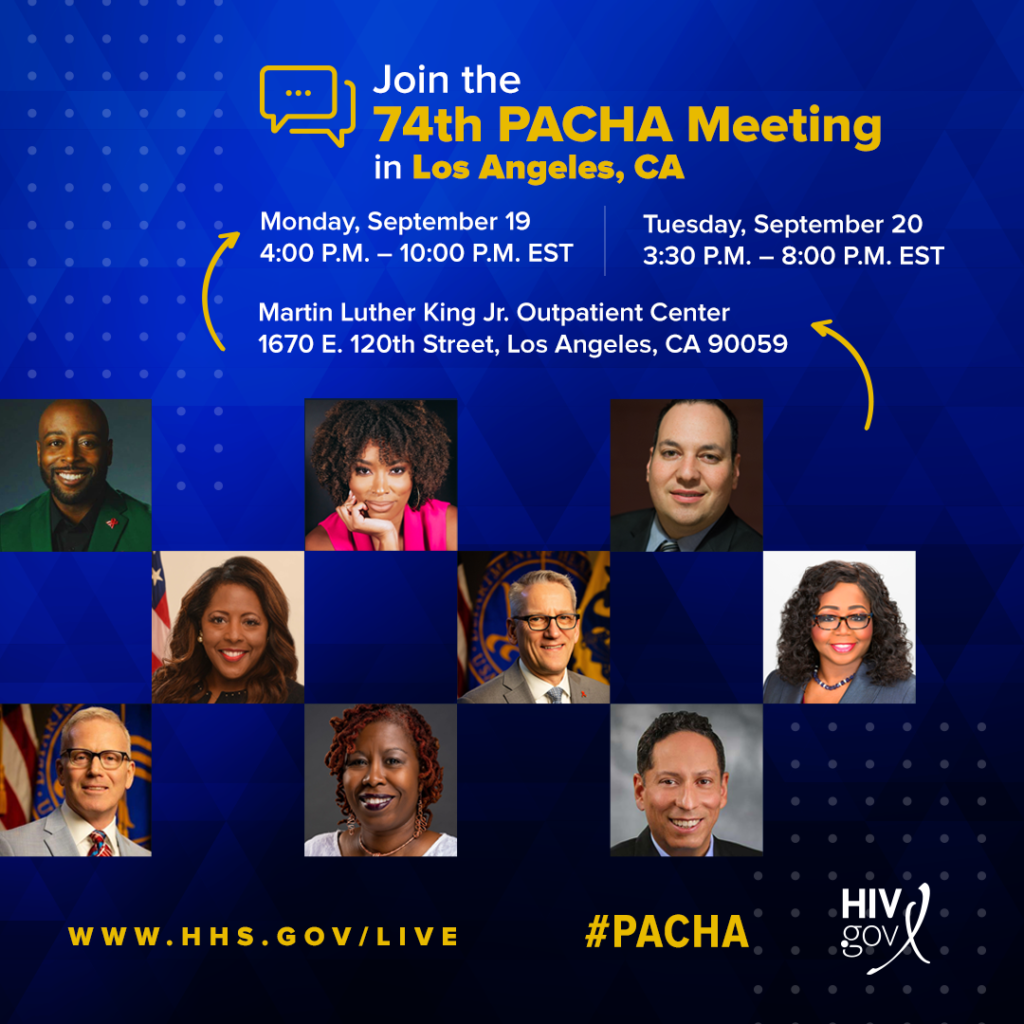
Announcement: 74th Presidential Advisory Committee on HIV/AIDS (PACHA Council) September 19 & 20 Promo Flyer

The 74th Presidential Advisory Committee on HIV/AIDS (PACHA Council) will be taking place in Los Angeles, CA on Monday, September 19, 2022 and September 20, 2022. The meeting will be hybrid for those who wish to participate virtually. It is open to the public and everyone.

See more details below regarding times and registration information:

  • When: Monday, September 19, 2022 from 4:00 – 10:00 pm (ET)/1:00 pm – 7:00 pm (PT) and September 20, 2022 from a 3:30 – 8:00 pm (ET)/12:30 pm – 5:00 pm (PT).
  • Where: Martin Luther King Jr. Outpatient Building, 1670 E. 120th Street, Los Angeles, CA 90059. (The closest metro stop is the Willowbrook/Rosa Parks station.) To attend the meeting virtually, please visit www.hhs.gov/live on date and time of event.
  • “PACHA-to-the-People”: PACHA wants to hear from you! There will be a Listening Session with audience attendees on September 19. This is an opportunity for our PACHA members and leaders to hear from the community. Please encourage the community to attend.
  • Registration: Due to limited seating, pre-registration for individuals attending in-person is encouraged. To register, please email your name to PACHA@hhs.gov by close of business Friday, September 9, 2022.
  • Public Comment: Pre-registration is required to provide public comment. To pre-register, please send an email to PACHA@hhs.gov and include your name, organization, and title by close of business Friday, September 9, 2022.
  • Agenda forthcoming: The meeting agenda will be posted on the PACHA page on HIV.gov prior to the meeting. The agenda will also be sent out once it is finalized. On the second day, community partners will be invited to participate on a panel to discuss the needs of the community.

For more information, please see the Federal Register Notice: View the Notice here.

Updates to the Guidelines for the Prevention and Treatment of Opportunistic Infections in HIV-Exposed and HIV-Infected Children (September 6)

Updates to the Guidelines for the Prevention and Treatment of Opportunistic Infections in Adults and Adolescents with HIV

Cross-posted from hivinfo.nih.gov

The HHS Panel on the Prevention and Treatment of Opportunistic Infections in HIV-Exposed and HIV-Infected Children (the Panel) updated the following section of the Guidelines for the Prevention and Treatment of Opportunistic Infections in HIV-Exposed and HIV-Infected ChildrenHighlights from the updated section are summarized below:

Monkeypox

  • The Panel added a brief statement about monkeypox with links to information from the Centers for Disease Control and Prevention.
  • Information about monkeypox as an HIV-related opportunistic infection in children with HIV will be added to this guideline as relevant data emerge.

For a list of recent updates, please see What’s New in the Guidelines. To view or download the guidelines, go to the Pediatric Opportunistic Infections Guidelines section of Clinical Info’s website. The guidelines tables and recommendations also can be downloaded as separate PDF files.

Clinical Info welcomes your feedback on the latest revisions to the Guidelines for the Prevention and Treatment of Opportunistic Infections in HIV-Exposed and HIV-Infected Children. Please send your comments with the subject line “Pediatric Opportunistic Infection Guidelines” to HIVinfo@NIH.gov by September 23, 2022.

New: Ryan White HIV/AIDS Program AIDS Drug Assistance Program Annual Client-Level Data Report, 2020

The HRSA HIV/AIDS Bureau (HAB) has released the Ryan White HIV/AIDS Program (RWHAP) AIDS Drug Assistance Program (ADAP) Annual Client-Level Data Report, 2020.

This publication reflects HRSA HAB’s ongoing commitment to ensuring the availability of program information. The report is the fourth publication of national ADAP client-level data submitted through the ADAP Data Report (ADR) system. ADR data describe the demographic characteristics of clients accessing ADAP services and the ADAP-funded services used.  Data are included for 2016 through 2020, nationally and by state/territory.

The publication provides a deeper look at service utilization, demographic, and socioeconomic factors among clients served by ADAP. The report includes client-level data based on age, race/ethnicity, federal poverty level, and health care coverage.

New: Biden-Harris Administration Bolsters Monkeypox Response; HHS Secretary Becerra Declares Public Health Emergency

Department of Health & Human Services LogoCross-posted from HIV.gov

U.S. Department of Health and Human Services Secretary Xavier Becerra announced today that he will declare the ongoing spread of monkeypox virus in the United States a Public Health Emergency (PHE). This action will further strengthen and accelerate the Biden-Harris Administration’s response in recognition of the continued rapid transmission of monkeypox in the U.S. and globally, and to signal the seriousness and urgency with which the Administration is responding. The announcement comes on the heels of President Biden appointing Robert Fenton of the Federal Emergency Management Agency as White House National Monkeypox Response Coordinator and Dr. Demetre Daskalakis of the Centers for Disease Control and Prevention as White House National Monkeypox Response Deputy Coordinator.

“Ending the monkeypox outbreak is a critical priority for the Biden-Harris Administration. We are taking our response to the next level by declaring a public health emergency,” said Secretary Becerra. “With today’s declaration we can further strengthen and accelerate our response further.”

“President Biden has called on us to explore every option on the table to combat the monkeypox outbreak and protect communities at risk,” said White House National Monkeypox Response Coordinator Robert Fenton. “We are applying lessons learned from the battles we’ve fought – from COVID response to wildfires to measles, and will tackle this outbreak with the urgency this moment demands.”

The PHE declaration is in concert with the Food and Drug Administration’s (FDA) work to explore new strategies that could help get vaccines to affected communities across the country, including using new dose-sparing approach that could increase the number of doses available, up to five-fold.

The public health emergency also carries important implications for data sharing with the federal government. Fifty-one jurisdictions have already signed data use agreements that will provide the Centers for Disease Control and Prevention (CDC) with information related to vaccine administration. Declaring the outbreak an emergency may provide the justification that the remaining jurisdictions need to sign their agreements. Additionally, it provides authorities to the Centers for Medicare & Medicaid Services to collect testing and hospitalization data.

As of today, HHS has shipped more than 602,000 doses of the JYNNEOS vaccine to states and jurisdictions, an increase of 266,000 in the past week. HHS has allocated 1.1 million doses to states and jurisdictions in total and is making more doses available as jurisdictions use their current supply. HHS also announced today that it has accelerated the delivery of an additional 150,000 doses to arrive in the U.S. next month. The doses, which were slated to arrive in November will now arrive in the U.S. in September.

Today’s announcements are part of the Biden-Harris Administration’s comprehensive strategy to combat the monkeypox outbreak.  The strategy includes significantly scaling the production and availability of vaccines, expanding testing capacity and making testing more convenient, reducing burdens in accessing treatments, and conducting robust outreach to stakeholders and members of the LGBTQI+ communities.